

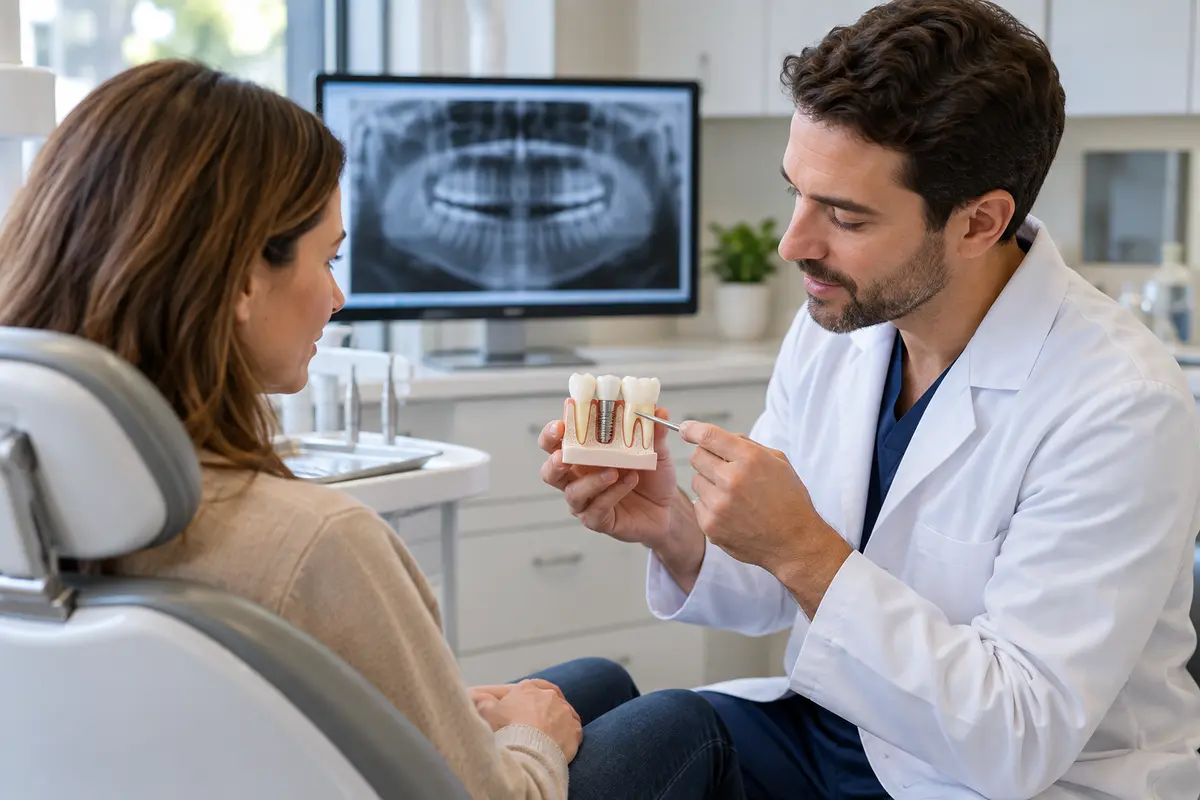
A dental implant can replace a missing tooth without preparing the neighbouring teeth for a bridge. The implant acts as an artificial root in the jawbone and supports a custom crown after healing. Suitability is always assessed individually.
When may an implant be useful?
Implants can replace one tooth, several teeth or support a larger prosthesis. The aim is to restore chewing, appearance and the continuity of the dental arch. A bridge or removable denture may sometimes be a better alternative.
Who may be suitable?
Healthy or treated gums, good oral hygiene and sufficient bone are important. Bone augmentation may be considered when bone volume is limited. Smoking, uncontrolled diabetes, active gum disease and certain medicines can affect the plan or increase risk. Tell the dentist about all illnesses and medication.
What are the treatment stages?
- Consultation, examination and imaging.
- Treatment of active dental or gum disease.
- Implant placement under local anaesthetic.
- A healing period while the implant integrates with bone.
- Making and fitting the custom crown.
- Regular maintenance visits.
Is implant placement painful?
Local anaesthetic is normally used. Tenderness, swelling or minor bleeding can occur afterwards. Contact the clinic if pain or swelling increases, fever develops or bleeding does not settle.
How should an implant be cleaned?
An implant cannot develop decay, but the surrounding gum and bone can become inflamed. Brush twice daily and clean around the implant with floss, interdental brushes or another recommended aid. Professional cleaning and check-ups are essential.
How long does an implant last?
No exact lifespan can be guaranteed. Oral hygiene, smoking, general health, bite forces and regular maintenance all influence the outcome. The crown may need repair or replacement over time.
Frequently asked questions
Can an implant be placed immediately after extraction?
Sometimes, but the decision depends on infection, bone and initial implant stability.
Is there an upper age limit?
Suitability is based more on health and oral conditions than age alone.
Why might a 3D X-ray be needed?
It helps assess bone volume and nearby structures for accurate planning.
For dental implants in Tartu, review Denslux services and contact the clinic.
